


Teacher Houming Qiu from the School of Software and Internet of Things Engineering Publishes a Significant Research Outcomes in Top SCI Journal IEEE TMC (CCF A)
Teacher Houming Qiu from the School of Software and Internet of Things Engineering Publishes a Significant Research Outcomes in Top SCI Journal IEEE TMC (CCF A)
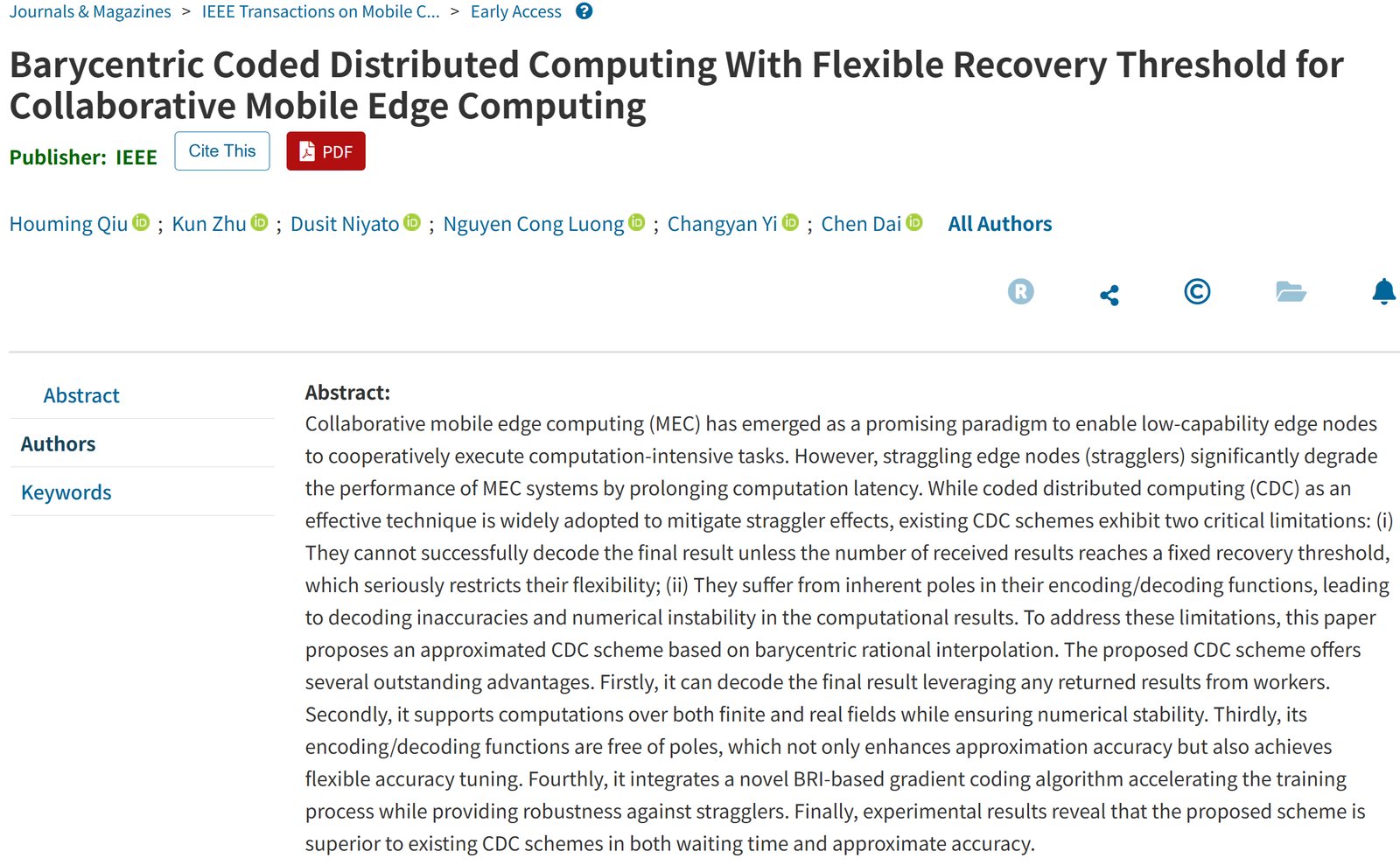
Recently, Dr. Houming Qiu, a young teacher from the School of Software and Internet of Things Engineering, published a research paper titled “Barycentric Coded Distributed Computing With Flexible Recovery Threshold for Collaborative Mobile Edge Computing” in the prestigious international journal IEEE Transactions on Mobile Computing (IEEETMC).This work proposes a Barycentric Rational Interpolation–based coded distributed computing scheme with a flexible recovery threshold (BRIcode). The BRI code is designed for collaborative mobile edge computing sscenarios and enables a coded computation scheme with a flexible recovery threshold, which significantly improves decoding efficiency and substantially enhances the system’s resilience to straggling nodes.
The main contributions of this study are threefold. First, to address the limitations of traditional coded computation schemes that rely on a fixed recovery threshold, we design a distributed coded computing scheme with a flexible recovery threshold, which supports an arbitrarily configurable number of required results. The master nodecan decode the final result once it receives any subset of results from the worker nodes. In particular, the state-of-the-art coding scheme BACC is a special case of the proposed BRI code. Second, to simultaneously support both the real field and finite fields while improving decoding accuracy, we design the encoding and decoding functions based on barycentric rational interpolation. Experimental results demonstrate that the proposed BRI code achieves higher decoding accuracy and decoding efficiency.Finally, we develop a BRI-based gradient coding algorithm to enable a straggler-resilient distributed linear regression algorithm, which achieves faster training and stronger robustness to stragglers compared with traditional approaches.
Dr. Houming Qiu’s research has not only received broad recognition and acknowledgment from experts in the field, but also provides a novel technical pathway and solution framework for enabling AIGC in mobile edge computing sscenarios, demonstrating significant theoretical value and broad application prospects.